
 4 months ago
88
4 months ago
88
ARTICLE AD BOX
Natalie ShermanBusiness reporter

 Bloomberg via Getty Images
The impact of the US and Israel's war in Iran is starting to hit home - no matter where you live.
As the conflict blocks oil exports from the Gulf region, and producers start to cut output, the supply shock has sent oil soaring toward $85 per barrel, rattling financial markets, driving up prices at the pump and raising fears of a bigger economic hit.
The war has been an unwelcome reminder of the world's ongoing dependence on the Middle East for energy supplies, recalling supply shocks that hit the world in the 1950s and 1970s.
But analysts say the impact this time is much larger.
Roughly 20% of the world's crude supply travels through the Strait of Hormuz, where the war has blocked ship traffic.
Analysts say oil and gas producers outside the region, in countries like the US, Brazil and Norway, have limited ability to ramp up production.
And while local oil pipelines have some capacity to serve as an alternate route, they do not have enough - forcing producers in the region to announce cuts. In Iraq, output is down by more than 60%, according to Reuters, while Kuwait and the United Arab Emirates are also scaling back.
Nor are the energy strains limited to oil. About 20% of the world's natural gas supplies are also down, after Qatar's state energy firm halted production, citing military attacks.
With no easy way to plug the gaps, analysts at JP Morgan say they expect "visible shortages" to emerge in Asia and Europe within a week.
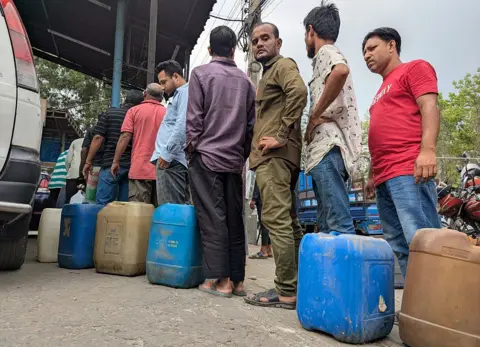 NurPhoto via Getty Images
In the UK, Chancellor Rachel Reeves has warned of the risks of an inflationary shock.
"This is essentially the biggest supply shock at least in modern global oil market history," Kornfeind said.
"We're talking apples to oranges in terms of the need."
What the shock means, for now, is higher energy prices.
Brent crude and the US benchmark, West Texas Intermediate, have both surged since the war began, approaching $120 per barrel at one point on Monday, before falling back to just under $85 per barrel.
That is feeding through to costs faced by businesses and households.
In the UK and Europe, natural gas prices have almost doubled since before the war in Iran began.
Even in the US, which as a major oil and gas producer tends to relatively shielded from global price fluctuations, prices at the pump are approaching $3.50 per gallon, up from roughly $2.90 a month ago, back to levels last seen in 2024.
Last week, Goldman Sachs estimated that a temporary rise in oil prices just to $100 per barrel could knock 0.4 percentage points off of global economic growth.
But if the conflict is not resolved by the end of the month, analysts say that it could push global oil prices above the recent 2022 peaks seen after Russia's invasion of Ukraine, with a chance of oil hitting $150 per barrel in some scenarios.
Kornfeind said that the knock-on impact for the economy would be "pretty drastic" at that point, as higher costs force households and businesses to reduce other spending and the wider economy slows.
Business impact, from tech to farmers
Analysts are already warily watching to see what it might mean for chip-making - a sector with ramifications for everything from cars to smart phones - since Taiwan, a hub of production relies heavily on energy imports.
In the US, some have also raised concerns that a jump in energy costs could weigh on tech firms trying to build out their artificial intelligence (AI) infrastructure, hitting a key driver of economic growth.
Nor is energy the only commodity that has been affected.
The Middle East is also a major source of aluminium, sulphur, which is used to process metals such as copper, as well as ingredients for fertiliser including urea.
As prices for those commodities start to creep higher, the pressure could feed through the costs of food and manufactured goods.
In the US, about 25% of fertiliser imports enter the US in the months of March and April, as planting season starts, according to the American Farm Bureau Federation.
"It could not come at a worse time," said farmer Harry Ott, who grows cotton, corn and soybeans in South Carolina.
He called his fertiliser supplier last week, aiming to start applying it to his fields, only to be told that the business was holding off on sales and deliveries until it had a better handle on the impact of the war.
The business has since announced a price hike, which he fears will raise his fertiliser bill by roughly $100 per acre and wipe out his chance of making any profit on this year's crop.
"These are trying times and what we are going through now on fertiliser ... was totally unexpected," Ott said in a briefing for reporters hosted by the Farm Bureau. "Nobody's balance sheet had room to make these adjustments."
 Bloomberg via Getty Images
Planting season in the US is gearing up
Analysts say the economic risks are greatest in Asia and Europe, which are heavily dependent on energy imports - concerns that have been reflected in the stock market.
In Japan and South Korea, for example, the main stock indexes have fallen by roughly 10% and 15% respectively since the war began, while Germany's Dax has fallen by more than 7%.
In the US, by contrast, the S&P 500 has fallen just 1.2%.
But with cost of living concerns top of mind ahead of congressional elections in November, analysts say the situation threatens to create a political problem for US President Donald Trump should price rises start to feed through to consumers.
The White House has sent conflicting signals about its plans for the region, raising doubts about whether the president will have a stomach for a prolonged fight.
Even if Trump calls the war to an end, however, analysts warned concerns about further turmoil could keep prices elevated.
"Much as the US and Israel may declare operations over and complete, the Iranians may not see it that way," warned Paul Stankey of Stankey Research. "That may mean this situation continues long beyond the declaration of hostilities by the Trump administration."








 English (US) ·