
 1 month ago
58
1 month ago
58
ARTICLE AD BOX
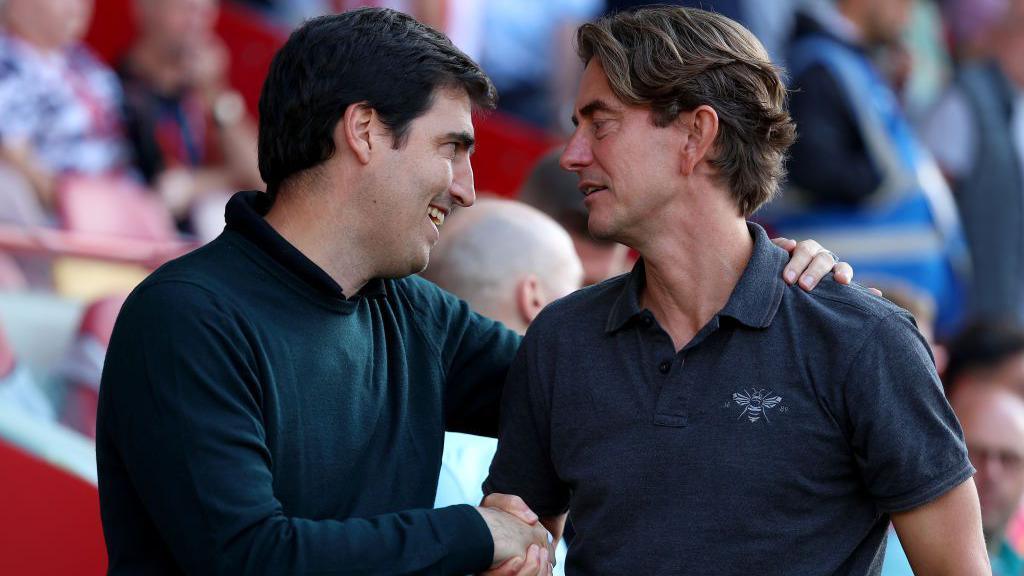 Image source, Getty Images
Andoni Iraola (left) is set to make the step up from Bournemouth to Liverpool, while Thomas Frank joined Tottenham from Brentford
ByPrudent Nsengiyumva
BBC Sport journalist
Moving from a successful Premier League side to a so-called 'big-six' club is sometimes seen as the natural next step for a manager.
By the 'big six' we are referring to Arsenal, Chelsea, Liverpool, Manchester City, Manchester United and Tottenham.
We do not use that term to disparage the likes of Aston Villa or Newcastle who have qualified for the Champions League in recent seasons, or indeed any other top-flight team.
But those six clubs have largely dominated the top of the table over the past 15 years or so.
So will Andoni Iraola, who has reached a verbal agreement with Liverpool, be able to make the step up from Bournemouth after finishing, ironically, in sixth place with the Cherries?
The data suggests it is one of the toughest transitions in the game - with short tenures, mixed results and no major silverware won by a manager taking that step within the Premier League.
In recent seasons, Thomas Frank, Graham Potter and Nuno Espirito Santo all struggled to make the leap.
For managers who earn a move to one of the Premier League's biggest clubs, the opportunity can arrive quickly. So too can the scrutiny.
The most consistent pattern is how short those spells tend to be. Of the managers BBC Sport has analysed, the majority failed to last two full seasons, with several dismissed before completing their first campaign.
David Moyes' appointment at Manchester United in 2013 remains one of the clearest examples.
Hand-picked from Everton by Sir Alex Ferguson - who urged supporters to "stand by your new manager" in his farewell speech - Moyes arrived with both backing and expectation. He was dismissed just 10 months into a six-year contract. The Red Devils missed out on Champions League qualification for the first time since 1995.
Roy Hodgson's move to Liverpool followed a different path but ended similarly. Appointed in July 2010 after leading Fulham to the Europa League final, Hodgson said he was honoured to be taking "the biggest job in club football".
But he was gone by January the following year - with the Reds 12th in the league having won just seven of their 20 matches.
Other managers followed a similar trajectory. Potter lasted 22 league matches at Chelsea after joining from Brighton, while Nuno managed just 10 at Tottenham after taking Wolves from the Championship to a Europa League quarter-final.
More recently, Thomas Frank's time at Tottenham reinforced the same trend, with the Dane joining Spurs after an impressive spell at Brentford but only lasting 26 games.
Even when managers have been afforded more time, success and stability proved elusive.
Mark Hughes spent about 18 months at Manchester City before being replaced, while Brendan Rodgers, Harry Redknapp and Mauricio Pochettino all completed more than three seasons at their respective clubs but without winning silverware.
Higher hopes and mixed results
The logic behind many of these appointments seems straightforward - managers who have outperformed expectations are tasked with delivering even better results with stronger squads.
But the reality is more complicated.
Points-per-game figures show a mixed picture. Rodgers improved significantly after moving from Swansea to Liverpool aged 39 in 2012.
He was seen as one of the top flight's rising managerial stars - and quickly raised hopes, with Liverpool going close to the title in 2013-14. But he could not recreate that success and was sacked in October 2015.
Redknapp also improved Tottenham's results after arriving from Portsmouth, guiding the club into the Champions League and establishing them in the top four.
Pochettino represents another example of relative success. After impressing at Southampton, he joined Tottenham in 2014 and developed a side that regularly challenged at the top end of the table.
The Argentine led Spurs to a second-placed finish in 2016-17 and their first Champions League final in 2019, where they were beaten by Liverpool. But poor results amid heightened expectations led to his dismissal later that year.
Beyond those examples, progress becomes less consistent.
Hughes' numbers at Manchester City were broadly in line with his record at Blackburn.
Hodgson's dipped slightly after moving to Liverpool, while Frank's fell after his switch to Spurs.
Elsewhere, the differences were marginal. Potter's Chelsea record showed only a slight improvement on his Brighton average, across a much smaller sample.
While a few managers improved their points-per-game rate, those gains were often modest and inconsistent.
In short, stepping up does not guarantee better results and - in some cases - performance declines.
No trophies - but some near-misses
Perhaps the most striking point is the simplest.
Since the current 'big six' took shape after City's 2008 takeover, no manager has stepped up to one of those six teams from another Premier League side and gone on to win a major trophy.
There have been near-misses. Rodgers came close to a Premier League title, while Pochettino was 90 minutes away from winning the Champions League..
Enzo Maresca had secured promotion when he swapped Leicester for Chelsea in 2024, but had not yet managed a game in the top flight before his move.
He went on to win the Conference League and the Club World Cup in what proved to be his only full season at Stamford Bridge.
Frank Lampard joined Chelsea from Championship side Derby County in 2019 and secured Champions League football in his first season, but was dismissed after 18 months.
Michael Carrick, who was recently appointed the permanent Manchester United head coach, managed in the Championship previously with Middlesbrough.
Why is the step up so difficult?
The reasons are not always immediately obvious, but they are consistent.
There are more matches, including European competition, and less time to prepare.
In the 2025-26 season, the traditional 'big-six' clubs played an average of 55 matches across all competitions - eight more than other Premier League teams.
Success at other top-flight clubs can come from clever transfer business and overperformance relative to resources.
In many cases, simply maintaining their Premier League status is a club's primary objective, with anything beyond that considered a bonus - a contrast to an expectation of delivering trophies.
Expectations shift from exceeding targets to meeting them consistently. Winning is no longer an incentive - it is a minimum requirement.
A run of poor form that might be tolerated elsewhere can quickly become decisive. The pressure is greater, the scrutiny more intense, and the margin for error smaller.
Even managers with strong reputations and clearly defined styles have found that adjustment difficult.
That does not mean the move is destined to fail. Redknapp, Rodgers and Pochettino variously show it can work - and Maresca's trophies show success is possible.
Iraola left Bournemouth after leading them to Europe for the first time, a rise that makes his next step even more significant.
Would a season in Europe at Bournemouth have been beneficial to Iraola? Or can the Spaniard buck the trend and end the trophyless streak of managers making a 'big-six' move?


 English (US) ·