
 2 months ago
69
2 months ago
69
ARTICLE AD BOX
2 hours ago
Nadine YousifSenior Canada reporter

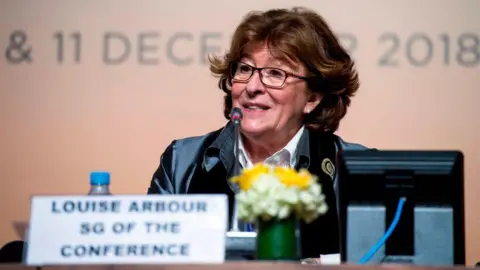 AFP via Getty Images
Arbour is a former Supreme Court of Canada judge and chief prosecutor of the International Criminal Tribunals
Prime Minister Mark Carney has appointed a bilingual lawyer and former United Nations high commissioner for human rights as Canada's new governor general.
Louise Arbour, 79, will soon replace current Governor General Mary Simon, who became the first indigenous person to hold the role when she was appointed five years ago.
The governor general serves as the representative of the Canadian Crown, currently King Charles III, in the commonwealth country and acts as head of state on the monarch's behalf. They typically serve five-year terms.
Carney has been under pressure to appoint a governor general that speaks both English and French - Canada's two official language - after Simon was criticised for her lack of French proficiency.
On Tuesday, the prime minister described Arbour as a Canadian whose entire life has been dedicated to "sound judgement, deep learning and an unwavering commitment to the rule of law".
Arbour was born in Montreal, Quebec, and had previously served as a justice on the Supreme Court of Canada, the country's highest court.
Outside of Canada, Arbour served as chief prosecutor of the International Criminal Tribunals for the former Yugoslavia and Rwanda. Carney called this role "her most consequential" as a jurist.
Arbour is credited for making history for the first-ever indictment of a sitting head of state, former Yugoslavian president Slobodan Milošević, as well as her prosecution of sexual assaults as crimes against humanity.
She is also credited for securing the first conviction for genocide since the 1948 Genocide Convention in the case of Rwanda.
Arbour later served as the United Nations human rights commissioner for four years, from 2004 to 2008.
Carney said Arbour "has held nearly every office a Canadian jurist can hold, and several that no Canadian has held before".
In 2007, Arbour received the Order of Canada, the country's highest civilian honour, for her contributions to the justice system both in Canada and internationally.
Speaking to reporters on Tuesday, Arbour said that she believes the constitutional monarchy in Canada has served the country "extremely well" and that it has provided continuity throughout its history.
Who has previously served in the role?
Arbour's appointment marks the end of Simon's term as governor general, which has been described as "historic" as no indigenous person had held the role before.
Simon, who is Inuit and born in northern Quebec, previously served as the ambassador to Denmark and as president of Inuit Tapiriit Kanatami, Canada's national Inuit organisation.
She is bilingual in English and Inuktitut - but not French, saying in the past that she had been denied the opportunity to learn the language while attending a federal day school in Quebec.
Simon was criticised for her French ability throughout her term. In 2024, she released a statement responding to critical media reports following a trip to Quebec, where she spoke mostly in English.
In that statement, she said she understood "the importance of French to French-speaking Canadians as a critical part of their cultures and identities".
On Tuesday, Carney called Simon an "exemplary" governor general who "carried forward a lifetime of advocacy for Inuit rights, for indigenous self determination, and for the preservation of our indigenous languages, cultures and identities".
Prior to Simon, Julie Payette, an astronaut, engineer, scientific broadcaster and corporate director, served in the role from 2017 to 2021.
The last governor general who did not come from the province of Quebec was David Johnston, who was born in Ontario. A former law professor and principal and vice-chancellor of McGill University, he served seven years in the role, from 2010 to 2017.

 English (US) ·