
 2 hours ago
5
2 hours ago
5
ARTICLE AD BOX
16 minutes ago
Jennifer McKiernanPolitical reporter

 Getty Images
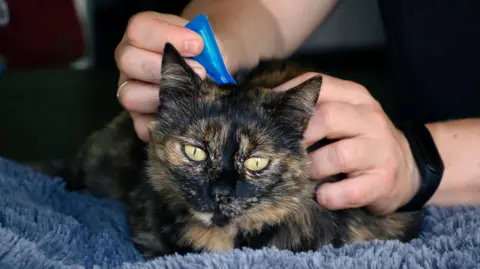
A cat has a flea spot-on treatment applied to the back of its neck
Over the counter flea treatments which are used by pet owners in the UK should be banned, a panel of vets has told a parliamentary inquiry.
Some environmental scientists have flagged two parasiticides found in most spot-on treatments to kill fleas and ticks on cats and dogs, fipronil and imidacloprid, as toxic to wildlife.
Giving evidence to a House of Lords committee on Wednesday, the vets said they wanted to see an end to year-round preventative treatments and a ban on the sale of spot-ons containing these chemicals by anyone other than vets.
The industry body representing flea treatment companies defended the use of preventive flea treatments as important for animal health.
Pet owners across the country have been advised they should treat their cats and dogs as a preventative measure every month, known as prophylactic use - although many veterinary organisations have now updated their advice.
The Lords' environment select committee heard from three vets, who said there was growing awareness that fipronil and imidacloprid were causing environmental damage and many vets have already moved away from using them.
Dr Elizabeth Mullineaux, the senior vice president of the British Veterinary Association (BVA), said recent surveys of the BVA's 20,000 members showed 80% supported a ban on general sale and more than 70% agreed blanket preventative treatment should stop.
"We're using these products really routinely and I think if you ask most vets what they do with their own pets, we don't treat our own pets in the way some practices are selling these products," she said.
Dr Martin Whitehead, senior veterinary surgeon at Chipping Norton Veterinary Hospital, said: "Almost all the parasiticides that are preventatively applied to pets are unnecessary."
Dr Rose Perkins, who is a practicing vet and a visiting Fellow at the Grantham Institute, said she had never given any preventative treatments to her puppy or her cat and had only needed to treat her cat once for fleas, which she did with an isoxazoline tablet rather than any spot-ons.
The evidence supported only using flea treatment in case of an infestation, she said, adding: "It's more in line with how we use antibiotics, it's much cheaper, you save a lot of money, and isoxazolines are incredibly effective."
 Getty Images
The Department for the Environment, Farming and Rural Affairs (Defra) is considering a ban on the general sale of spot-on flea treatments, launching a call for evidence last month, along with a campaign encouraging pet owners to use spot-ons correctly.
However, the vets said they did not believe this would go far enough to tackle the problem, with Perkins telling peers that only one in 100 vets she had surveyed used fipronil as the primary product for flea treatment for their own pets, adding: "They know it's polluting and they know it's ineffective."
She added government-funded research showed that pollution is still happening when owners were applying spot-on treatments correctly, so the current advice on application was wrong, as was failing to advise against preventative treatment.
"Pollution is occurring through correct use," she said. "There's actually no evidence that incorrect application or incorrect disposal of the product is a source of pollution."
Evidence from the vets' panel followed a session last week when three environmental scientists gave evidence on their research, telling peers there was strong evidence that these two chemicals wash off into water, where they go on to kill off insects at the bottom of the food chain for fish, birds and other mammals.
The scientists highlighted that both neurotoxins had been banned for use as agricultural pesticides in the UK in 2017 and 2018 respectively, due to evidence they were killing off bees, butterflies and other pollinators.
Ecological consultant Matthew Shardlow said he believed the active ingredients in flea treatments are so toxic, and so easily transferred onto humans, household items, and into water, that they should be withdrawn from sale.
Asked whether he thought a ban was necessary, Shardlow said: "We know enough to act, we don't need more information for fipronil and imidacloprid as we've got absolutely all the evidence we need.
"They've been banned in agriculture actually on probably less evidence than we've currently got for the flea treatment issue here at the moment."
He stressed getting levels of fipronil and imidacloprid down to safe levels would not be possible under current government guidance, which does not advise pet owners to stop monthly preventative treatments, but instead only gives guidance on correct use of the products.
Guy Woodward, an ecology professor at Imperial College London, said imidacloprid is highly water soluble and caused damage to wildlife in even very small amounts, the equivalent of two sugar cubes in 400 Olympic sized swimming pools.
He said: "These things are toxic, extremely toxic, in extremely small concentrations... and it's only now we're starting to glimpse the full scale of contamination."
Protecting animal welfare
The Veterinary Medicines Directorate (VMD), the regulator funded by government and by the pharmaceutical industry, said they wanted to limit the environmental impacts of flea and tick spot-ons and pointed to their consultation and awareness campaign.
A spokesman said: "We want to hear as many perspectives as possible in this consultation to help us maintain appropriate market availability while also protecting our animals and the environment."
Dawn Howard, chief executive of NOAH (National Office of Animal Health), which describes itself as the trade association representing the UK animal health industry defended the use of preventative flea treatments.
She said: "Parasite control and preventive medicine remains an important part of protecting animal health and welfare."
Howard cautioned against drawing conclusions before Defra's consultation conclusions and said the UK has a robust regulatory system for veterinary medicines.









 English (US) ·