
 2 months ago
71
2 months ago
71
ARTICLE AD BOX
6 minutes ago
Ana Faguy,on Capitol Hilland James FitzGerald

 Getty Images
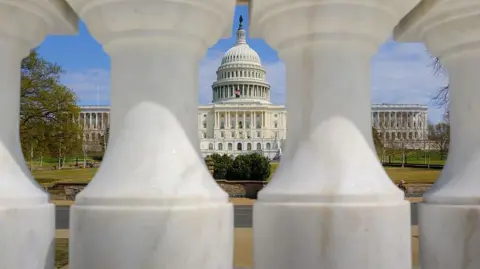
The US Senate has cleared a key hurdle as Congress looks to secure funding for two immigration enforcement agencies and allow the government to reopen in full.
In a late-night voting session, Republicans in the upper chamber of Congress used a procedural manoeuvre that did not require the support of opposition Democrats.
Democrats have been refusing to fund the two agencies, unless they are reformed in the wake of two deadly shootings by the agencies' operatives in the state of Minnesota.
Both Thursday's resolution, and a separate measure aimed at unlocking funding for the rest of the Department of Homeland Security (DHS), now require approval from the House.
It is not clear when the lower chamber might take up either measure. House Republicans have sometimes taken a different approach to the issue to their colleagues in the upper chamber.
The measure passed in the early hours of Thursday is designed to specifically fund the two agencies, Immigration and Customs Enforcement (ICE) and Customs and Border Protection (CBP), until the end of President Donald Trump's term.
The Senate had previously passed the separate measure that would fund the rest of the wider DHS, of which both agencies are a part.
The top Republican in the Senate, John Thune, hailed Thursday morning's result, but acknowledged that there was still "a multi-step process ahead of us".
Republicans used a procedure that allows lawmakers to pass spending-related matters with a simple Senate majority - after negotiations with Democrats proved ineffective.
It passed by 50 votes to 48. Two Republican senators who frequently break with the Trump administration joined Democrats to vote against it, and another did not vote.
Voting dragged on until about 03:30 local time (07:30 GMT), as Democrats tabled a series of amendments in a process sometimes known as a "vote-a-rama".
Trump has said he wants a budget package to be on his desk for signature by 1 June.
DHS has gone without funding since a shutdown began on 15 February, as the two sides have struggled to agree on a funding deal.
The shutdown represents the longest ever shutdown of a part of the US government.
Democrats have been demanding reforms to the agency as part of any funding deal, after federal agents shot dead two Minneapolis residents, Alex Pretti and Renee Good, amid immigration raids in Minnesota in January.
As the weeks have gone on, and the Senate and the House have been unable to find a common solution to fund DHS, the department's lack of funding has impacted ordinary Americans.
The impasse in Congress led to chaos at airports in March due to a shortage of security officers at checkpoints. Hundreds of security officers employed by DHS either quit their jobs or did not show up for work, causing airport security queues to reach car parks.
When Trump signed an executive order that required DHS to use existing money to pay the security officers, the pressure on lawmakers to agree to a funding solution dissipated somewhat.
But together with the lack of funding, Trump's June deadline and recent remarks from Homeland Security Secretary Mark Mullin, the pressure has mounted again.
Mullin told Fox News this week that his department would run out of money to pay employees' salaries in the first week of May.
"I've got one payroll left and there is no more emergency funds, so the president can't do another executive order because there's no more money there," he said.







 English (US) ·