
 1 hour ago
7
1 hour ago
7
ARTICLE AD BOX
12 minutes ago
Christine Jeavansand Matt Murphy,BBC Verify

 BBC
BBC
Thousands of people have been killed across the Middle East since the US-Israeli war with Iran began in February, official figures show, with a deal now agreed to end the war.
More than 7,300 people have been killed in Iran and Lebanon since 28 February, according to official casualty reports from those countries. Among them are hundreds of children and dozens of healthcare workers. Scores more people have been killed across the wider region.
However, some analysts say the figures are almost certainly an undercount and experts told BBC Verify that internet, media and government restrictions - coupled with unreliable figures due to the presence of armed groups in some areas - have hampered reporting.
Dr Iain Overton - executive director at the UK-based charity Action on Armed Violence - said the conflict being fought across multiple countries means casualty figures "are often incomplete, delayed or impossible to independently verify".
He added that "the final death toll will likely remain contested" for years after the conflict ends.
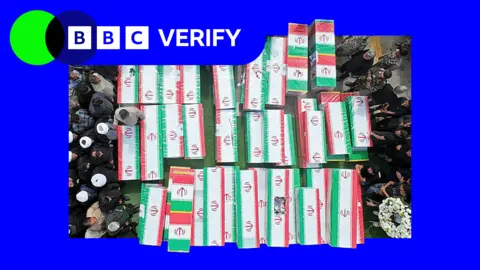
As of mid-April, at least 3,468 Iranians, including 499 women, had been killed since US and Israeli strikes began, according to official Iranian government figures.
This is made up of 1,460 civilians and 2,008 military personnel, state news agency IRNA reported on 26 April.
But the US-based Human Rights Activists News Agency (HRANA) said that their count was higher, with 3,636 killed.
In a report issued on 18 May, HRANA said their figure comprised 1,701 civilians, including 307 children, 1,221 military personnel, and 714 individuals whose identity or status could not be confirmed.
The organisation said their documented figures should be seen as "absolute minimums", as getting information on deaths was severely limited by difficulty accessing sites, government-imposed internet blackouts and political repression.
"Authorities routinely withhold information about casualties, and families may face pressure not to speak publicly about the circumstances of a death," said Skylar Thompson, the organisation's deputy director.
 Reuters
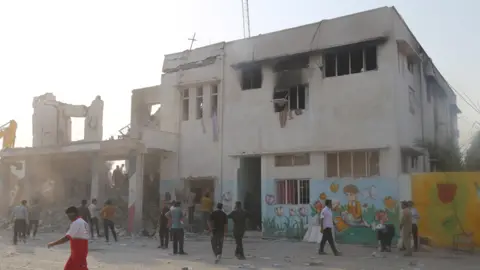
Days later, Iranian authorities said 20 people were killed when a missile hit a sports hall during a girls' volleyball match in the town of Lamerd.
The conflict between Israel and Hezbollah restarted on 2 March when Hezbollah launched rockets into Israel in retaliation for the killing of Iran's supreme leader. Israel responded with a campaign of air strikes and a ground invasion in southern Lebanon.
Since then, Lebanese health authorities say that 3,912 people have been confirmed as killed in Israeli attacks, among them 366 women and 247 children.
It's not clear whether or how many Hezbollah fighters are among them. BBC Verify contacted the health ministry but has not received a reply.
While Hezbollah has not released its own figures, Israeli Prime Minister Benjamin Netanyahu said last month that 3,000 fighters had been killed since the war with Iran began.
In early March, the Lebanese health ministry said 41 people were killed in a major Israeli air and ground operation around a town in the eastern Bekaa Valley. The IDF said its troops were recovering the remains of an Israeli military airman who went missing during a previous conflict in Lebanon 40 years ago, but Lebanese officials said three of its troops were killed - alongside a number of civilians and children.
Meanwhile, the United Nations says seven of its peacekeepers have also been killed in Lebanon, the most recent on 4 June.
 Reuters
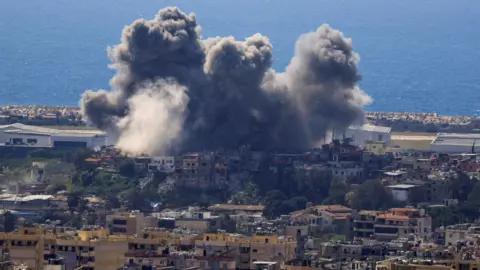
Smoke rises following an Israeli strike on the southern suburbs of Beirut
The Israeli campaign has attracted significant criticism for inflicting heavy civilian casualties. On Tuesday, US President Donald Trump sharply attacked the IDF's conduct, saying that "too many people have been killed" by the strikes.
"You don't have to knock down an apartment house every time you're looking for somebody, because there are a lot of people in those apartment houses, and they're not all Hezbollah," Trump said at the G7 summit in Paris.
Israeli authorities say 60 people have been killed, most by Iranian attacks and fighting with Hezbollah.
Among these were 29 civilians, 21 of whom were killed in Iranian missile strikes, according to government figures supplied to the BBC. Another 31 were IDF soldiers killed in combat. One person was killed in accidental friendly fire, the government said.
Israel has frequently accused Iran of deploying cluster munitions against population centres in the country. In one attack, the IDF said a couple in their 70s were killed while travelling to an air raid shelter after bomblets released by a cluster bomb hit the town of Ramat Gan.
In March, Human Rights Watch (HRW) accused Tehran of committing war crimes by targeting civilian centres with cluster munitions.
"Cluster munition bomblets are dispersed over a wide area, making them unlawfully indiscriminate in violation of the laws of war," said Patrick Thompson, a crisis, conflict and arms researcher with HRW.
Deaths across Middle East
Iran's initial response to US-Israeli strikes also saw it strike against neighbouring Arab states hosting US bases.
Iranian forces launched waves of ballistic missiles and explosive drones, many of which hit a range of civilian locations, including airports, energy facilities and ports. In many cases falling debris from interceptions fell on residential areas.
BBC Verify has previously documented attacks on military bases in eight countries - Saudi Arabia, the United Arab Emirates (UAE), Qatar, Kuwait, Iraq, Jordan, Bahrain and Oman.
The wave of strikes have prompted angry responses from Iran's neighbours. Dr Anwar Gargash - an adviser to the UAE's president - wrote on X: "Your war is not with your neighbours, and through this escalation, you confirm the narrative of those who see Iran as the region's primary source of danger.
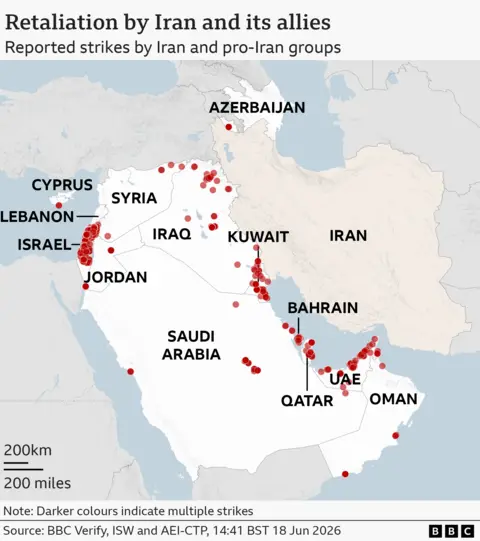
Reaching a definitive total for deaths across the region is difficult as not all states have published cumulative tolls. However, official statements and media reports have recorded deaths in most of the Gulf states, including 13 in the United Arab Emirates, according to the country's defence ministry.
In Iraq, more than 100 people have died, according to figures gathered by Al Jazeera and Agence France Presse. Of those, at least 80 were reported to be members of the paramilitary Popular Mobilisation Forces (PMF), which is dominated by Iran-backed Shia militias, killed in US and Israeli strikes.
Meanwhile, 13 US military personnel based in the Middle East have also been killed, seven in Iranian attacks and six in a refuelling plane crash in Iraq, according to the Pentagon.
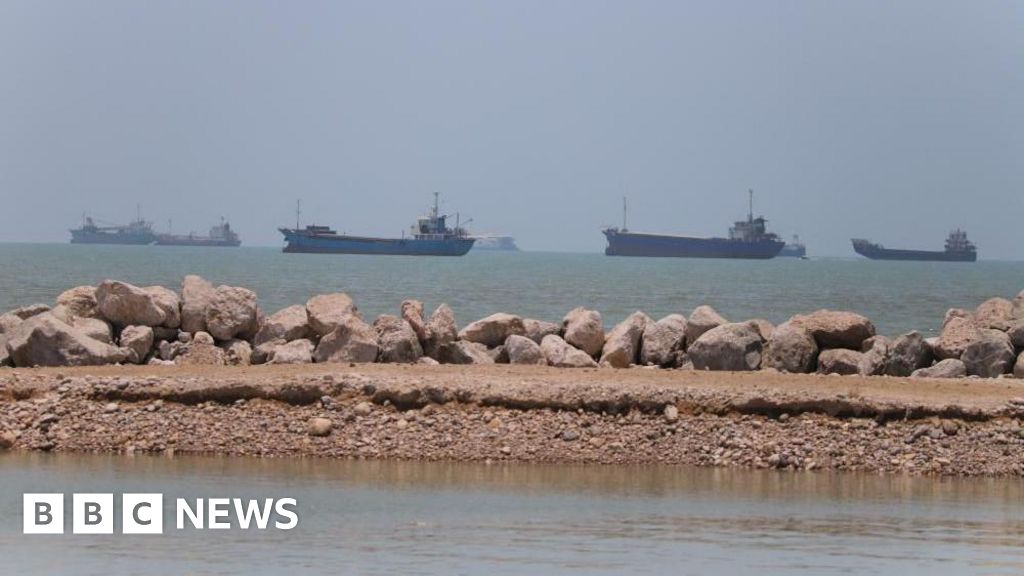
The International Maritime Organisation said 14 sailors with a range of nationalities had died in strikes on vessels in the Strait of Hormuz and elsewhere in the Middle East.
Dr Overton noted that "access restrictions, damaged infrastructure and political sensitivities" in parts of the Middle East have limited reporting and in some cases suppressed casualty numbers entirely.
"Experience from conflicts in Iraq, Syria and elsewhere suggests that the final death toll will likely remain contested and could prove substantially higher than the numbers currently available," Dr Overton said.




 English (US) ·