
 4 months ago
92
4 months ago
92
ARTICLE AD BOX
Harry FarleyPolitical correspondent

 EPA
EPA
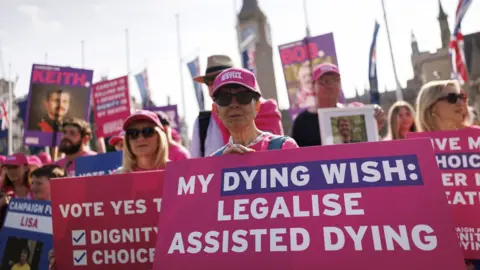
Failing to pass assisted dying legislation would undermine trust in politics, the prime minister has been warned by more than 100 Labour MPs.
In a collection of letters to Sir Keir Starmer, parliamentarians have urged him to make sure there is enough time for a decision to be reached.
Opponents warn the bill is flawed and any attempt to push it through would be unsafe and would harm vulnerable people. Downing Street has previously said it was a matter for parliament.
Proposed legislation that has not been introduced by the government must pass all its parliamentary stages before the end of each session, which usually last between one and two years.
If it runs out of time, the legislation typically fails.
Supporters now believe it is "effectively impossible" for the bill to legalise assisted dying in England and Wales to pass before the end of this session, expected in May.
This is largely because more than 1,200 amendments have been tabled in the House of Lords, principally from opponents to the legislation.
With only three of 14 days of debate in the Lords remaining, around half of the amendments are yet to be discussed.
Labour MP Jess Asato, who opposes the bill, said: "The sponsor of the bill has rejected 99% of suggested improvements and amendments in the House of Lords and so it still contains all the same faults and issues."
She added: "Any MP that voted to push this bill through would do so knowing that it is unsafe and would harm vulnerable people."
A source working with Labour opponents to the bill said: "For Labour MPs to continue to agitate for this unsafe, badly written and divisive bill rather than focus on the reasons people voted for us at the election is madness.
"Labour needs to work on delivering on our manifesto and running the country well, not rerunning contentious arguments about assisted dying."
More than 100 Labour MPs who back the change have written to the prime minister, with further letters from MPs in other parties, asking him to guarantee "time will be found for Parliament to come to a decision in the next session".
Peter Prinsley, a consultant doctor and MP for Bury St Edmunds and Stowmarket, organised the Labour letter.
He wrote: "While we fully respect the government's neutrality on the principle of assisted dying, we are confident that you would agree with us that we cannot be neutral on the fundamental democratic principle that it is for the elected House of Commons to decide on this matter."
He added: "We believe this is a matter of great importance that threatens to undermine public trust in our ability as politicians to deliver on their priorities."
Letters from supporters in other parties have been organised by Kit Malthouse for the Conservatives, Christine Jardine for the Liberal Democrats, Richard Tice for Reform UK and Ellie Chowns of the Green party.
In total around 150 MPs have written to the Prime Minister.
The calls will add pressure on Sir Keir to intervene.
He voted in favour of the change in the Commons but has insisted the government will remain neutral.
When previously asked about the issue returning in the next session, the prime minister's spokesperson said: "The government is neutral on the matter of assisted dying and the passage of the bill.
"It is for parliament to decide on any changes to the law."
Ethical issues, such as those around life and death, are conventionally seen as matters for the consciences of individual MPs, so the government does not formally give a position.
One way backbench MPs can suggest a change in the law is through entering a ballot that takes place at the start of each parliamentary session. However, unless an MP is drawn in the top handful their chosen legislation is unlikely to be debated, let alone have enough time to pass into law.
But Prinsley is asking that regardless of whether a supporter of assisted dying is drawn in the ballot, space is created in the parliamentary timetable for a decision on whether the change should be made.
"Our ask is simple," he wrote. "That, whether or not the bill returns through the private members' bill ballot after the Kings Speech, time will be found for Parliament to come to a decision in the next session.
"It would remain a conscience issue for MPs, the government's neutrality would be maintained, and it need not take up time reserved for government business."




 English (US) ·