
 1 month ago
43
1 month ago
43
ARTICLE AD BOX
21 minutes ago
Kelly Ngand Jake Kwon,Seoul correspondent

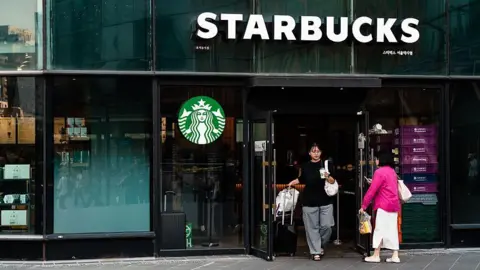 Getty Images
The campaign referred to a bloody crackdown on pro-democracy activists in 1980
Starbucks Korea's chief executive has been sacked over a campaign perceived as referring to a bloody historical incident.
Launched on Monday, the anniversary of the Gwangju Uprising crackdown, the "Tank Day" coffee tumbler promotion sparked calls to boycott Starbucks Korea and prompted a harsh rebuke from President Lee Jae Myung.
Many felt the "tank" motif referenced vehicles deployed by the military government in May 1980 to crush pro-democracy protesters.
Starbucks Korea rolled back the promotion hours after it launched. Shinsegae, the conglomerate that owns the majority stake in the coffee chain, apologised for "inappropriate marketing" and fired the chain's chief executive Sohn Jeong-hyun.
The promotion, which used the English words "Tank Day", was for their Tank Series drink tumblers touted to have "spacious volume" for a large amount of coffee.
According to local reports, Starbucks initially clarified that the Tank Series was one of several series of tumblers it was rolling out in a campaign running from 15 to 26 May.
"We sincerely apologise for causing inconvenience and concern to our customers due to this," the company said. "We have immediately suspended the event and will review and improve our internal processes to prevent similar incidents from recurring in the future."
"I can't believe they thought they could pull off something like this and people would just let it slide... it's utterly absurd and infuriating," an X user wrote early on Tuesday.
Several also put out calls on social media to boycott both Starbucks Korea and Shinsegae.
South Korea's president was among those who criticised the campaign, saying it "insults the victims and the bloody struggle" of the residents of the southern city of Gwangju.
"What on earth were they thinking, knowing how many lives were taken that day and how seriously that set back our country's justice and history?
"I am outraged by such a low-class merchant's inhumane behaviour, which denies our country's values of basic human rights and democracy," Lee wrote on an X post.
Reports estimate that hundreds of demonstrators were killed in the southern city of Gwangju on 18 May 1980.
Further investigations into the massacre later confirmed that troops deployed by the military regime of Chun Doo-hwan committed rape and sexual assault.
Since then, 18 May has frequently been depicted in films and television shows as a day of national trauma for South Korea while also commemorated annually as a sacred day of democracy.
The Gwangju Uprising set South Korea on its path toward democracy. It became a rallying cry for activists over the following seven years, culminating in a movement in June 1987 which toppled Chun's regime.
Some in South Korea claim the Starbucks Korea campaign also references the 1987 movement.
Promotional material for the tumbler had the phrase "tak on the table!" in Korean, using a word that sounds like an object being slapped on a table.
"Tak" was also the word used in a controversial statement given by police in 1987 about the death of a student activist in custody.
Police had said the activist collapsed and died after an interrogator slapped the table forcefully, when in fact the activist died after he was tortured.
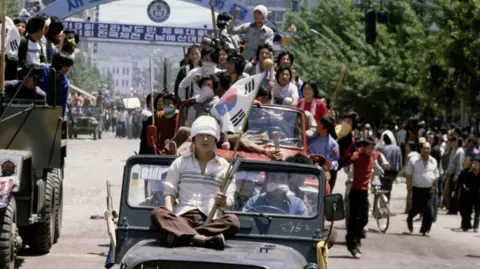 Getty Images
Protesters comandeering military vehicles during the Gwangju Uprising in May 1980
Shinsegae's group chairman Chung Yong-jin called the Starbucks campaign "an inexcusable mistake that trivialised the suffering and sacrifices of all those who have dedicated themselves to the democracy of this country".
In a statement published on Tuesday, he pledged to "thoroughly investigate" the approval procedures behind the event and "re-examine the review process" for marketing content across all its affiliates.
Since it sold off its stakes in July 2021, Starbucks Coffee Company, headquartered in the US, no longer has any involvement in Starbucks's operations in South Korea.
Shinsegae's subsidiary E-mart owns a 67.5% controlling stake in Starbucks Korea, while the remaining share is owned by Singapore's sovereign wealth fund GIC.


 English (US) ·