
 1 month ago
54
1 month ago
54
ARTICLE AD BOX
Just now
Simon Jack Business editor
 BBC
BBC
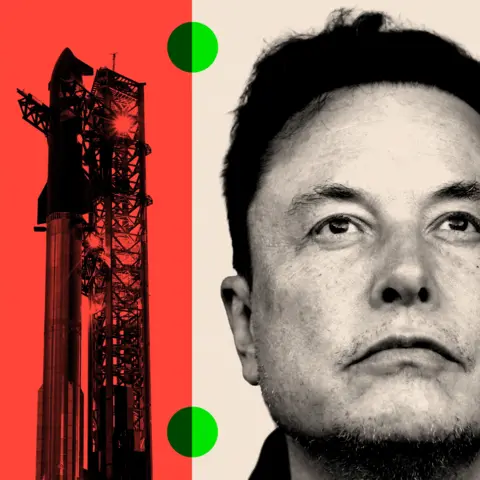
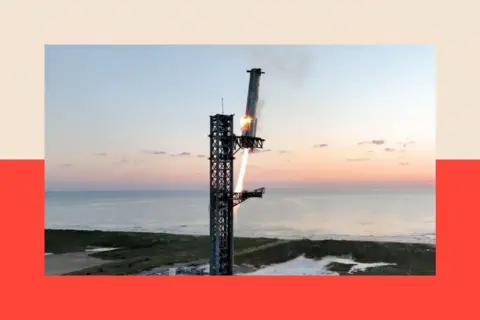
It's 07:25 am, 13 October 2024, at Starbase, near Boca Chica on the Texas side of the US/Mexico border, and on the launch pad stands the biggest rocket ever made. Its engines fire and it climbs into the skies over the Gulf of Mexico to cheers and screams in the SpaceX control room.
But the launch is not the main event. What goes up must come down – and how it comes down will become a milestone in space exploration.
Seven minutes later, the massive rocket booster that blasted the craft towards space starts falling back to Earth – until its engines reignite as planned. It slows its descent and guides itself with pinpoint precision so it can be captured by a clasp called Mechazilla, or "the chopsticks", by engineers who have achieved something that's never been done before.
Amid the whoops and high-fives in SpaceX's control room, Elon Musk tells his millions of social media followers that this is a "big step towards making life multiplanetary" - a reusable rocket that will slash the costs of launching things into orbit, to the Moon and one day to Mars.
A company with a futuristic vision, led by what some would call a maverick unconventional genius, SpaceX and Musk have drawn comparisons with Tony Stark, leader of Stark Industries and also known as Iron Man of the Marvel Comics Universe.
 Anadolu via Getty Images
The launch of Starship in October 2024 marked another milestone in Elon Musk's ambitions for deep-space exploration
On 12 June, trading will begin in a chunk of shares in a company that, up to now, only Musk and a select group of rich private institutions have been able or invited to own.
It is perhaps little wonder that more than one UK stockbroker has told the BBC that there has been "a surge" in interest in signing up for the chance to buy shares in this exciting company, controlled by a talismanic individual, that has captured the world's imagination. UK retail investors are likely to be allocated around £1.5bn worth of shares and one of the UK's leading investing platforms hopes this could encourage a new generation of investors.
Simon Belsham, Chief Client Officer at Hargreaves Lansdown said: "While we recognise this IPO might not be right for everyone, it's an exciting moment for many of our clients. We're expecting this might be a first foray into investing for many."
Even if you don't apply directly to buy shares, if you have retirement savings invested in shares - as almost everyone with a pension plan does - then it is very likely you will soon be a part-owner of a company, whether you like it or not, that sits at the crossroads between technology and geopolitics and, as Musk would have it, the very future of the human race.
The chance for normal Earthlings to buy shares in SpaceX is one of the most important moments in the history of stock markets and is close at hand – and one that will almost certainly make Elon Musk the world's first ever trillionaire.
 Reuters
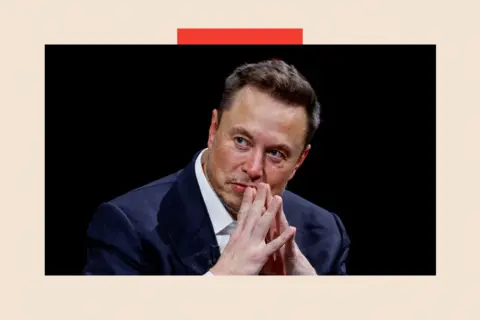
A SpaceX stock market listing could make Elon Musk the world's first trillionaire
On the first few pages of the prospectus – or sales brochure – for SpaceX shares is this modest mission statement: "To build the systems and technologies necessary to make life multiplanetary, to understand the true nature of the universe and to extend the light of consciousness to the stars."
But SpaceX isn't just about rockets – it's not even mainly about rockets. It's a bet on the future of artificial intelligence (AI). And the success or failure of its imminent partial sale to the public is an important test of the hitherto unbridled investor optimism – and some people's dismay - that AI will hoover up large parts of the world economy.
The continued concentration of power in a few US mega-corps also poses important questions about the way business, economics and politics works here on Earth. And many think this is Musk's Icarus moment – when he flies too close to the sun. "I think it's an Elon Musk ego project," says Sinead O'Sullivan, an economist who has worked for Nasa in the past.
So should we be pleased we will all likely be passengers on his astral journey?
SpaceX has filed for an initial public offering (IPO) of its shares. Although it's only selling a portion of the company to the likes of us, the price of the shares Elon Musk is selling means we can calculate the price tag of the whole company.
The bankers selling the shares have put a target price tag on the company on $1.75trn - which puts it comfortably in the top 10 most valuable companies on Earth.
That is a staggering valuation for a company that lost nearly $5bn (£3.7bn) last year. So what are we buying?
SpaceX is in fact several businesses in one company. It designs rockets as well as manufacturing and launching its own and other people's satellites. Its launch capabilities alone dwarf that of any other company – or indeed country on Earth.
Its own satellites also form the basis of the Starlink communications network, which has proven to have crucial geopolitical importance during Ukraine's defence against the Russian invasion.
This is a profitable business and one that generates significant income. But even the most optimistic estimates value this part of SpaceX at around $300bn - less than 20% of SpaceX's $1.75trn target valuation.
The real bet is on AI because bundled into SpaceX is Elon Musk's AI company xAI, along with a deeper space programme with plans to create data centres in space providing vast computing power – powered by the sun, cooled by the chill of space - while creating human-crewed bases on the Moon and eventually Mars.
The success of SpaceX depends to a huge extent on its AI business. Of the $28.5trn market that SpaceX has identified for its services, known as its total addressable market – $26.5trn of that is in AI.
To believe that, you need to believe that the AI industry will be comparable in size to the entire economy of the United States or all of Europe.
The SpaceX prospectus estimates that the space and communications sector is less than 10% of the $28trn total - and yet those are the only businesses that SpaceX has demonstrated commercial and technical advantages.
"If we look at the business itself, it's really unclear as to what business or industry SpaceX is even in," says O'Sullivan.
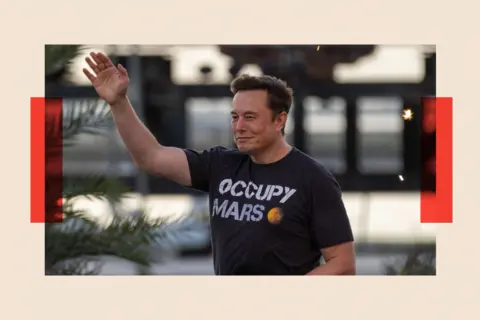 Getty Images
SpaceX's ambitions go beyond rockets, including artificial intelligence, computing and future missions to Mars
"The logo, the brand is built on two decades of rocketry but most of the capital expenditure is actually on data centres and an AI company that seems to be more about social media than anything to do with space," she adds. "All of these are just in a kind of conglomerated business under Elon Musk's name."
The prospectus admits that SpaceX will have to do things no company has ever done before. It says it "requires, building, commercialising and operating products and services… at a scale that has not been previously achieved".
O'Sullivan is sceptical. "When we look at the massive share price that they are trying to get here, you're buying a share of the Elon Musk brand more than any kind of space industry."
Ownership without control?
But there is no shortage of evangelists who will point to Musk's staggering ability to raise money, challenge orthodoxy and prove his doubters wrong.
He took on the combined might of the global car industry and within 20 years of its founding his carmaker Tesla was worth more than Toyota, Ford, General Motors and Volkswagen combined.
The other reason that some investors intend to pass on the opportunity to invest in Musk's greatest adventure yet is their objection to the total control he will exert over the company.
Musk is listed as founder, chief executive, chief technical officer and chairman of the board.
Even though he only owns 42% of the company, his shares come with extra voting rights meaning he effectively controls 85% of the company.
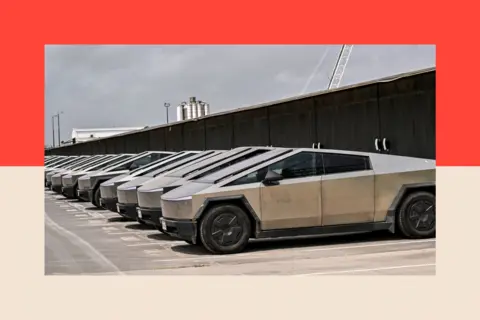 Reuters
Tesla's market value has grown rapidly, overtaking several long‑established carmakers combined value in less than two decades
Financial journalist Robert Armstrong asks: "What is holding shares in a company? It's ownership - but what kind of ownership is this? Do you really own something you can't control?"
Armstrong adds that investors should get a discount for forfeiting control: "I want to pay less for a company where my ownership does not include control."
But as one large institutional investor told the BBC, "the cult of Elon Musk requires disciples to pay a premium for the questionable privilege of having no real say in how the company they own is run. But people seem happy to do that."
And that control is in the hands of a man who has used his power and wealth in controversial ways. He spent nearly $300m on Donald Trump's second run for office. He has secured billions in US government contracts and dabbled in the internal affairs of other nation states by supporting right-wing figures in the UK and elsewhere.
Nevertheless, betting against Elon Musk has not been a wise strategy in the past. He didn't become the world's richest man – with a personal fortune of over $700bn, and soon to be over $1trn – without proving his doubters wrong.
Since 2020, estimates of SpaceX's value have risen from $40bn to a price tag of $1.75trn – a more than 40-fold increase - while shares in Tesla have risen tenfold in the same period.
And that has happened even as Tesla's car production numbers have plateaued.
The renewed upward trend in Tesla's share price despite falling sales speaks to another of Musk's great gifts, dangling new and ambitious targets to justify the valuation – in this case a promise to pivot towards robotics with a target to build one billion humanoid robots.
That ability to swerve and adapt prompted one big investor to tell the BBC "he's more [the famous showman] P.T. Barnum than Rockefeller or Buffett".
But FOMO – the fear of missing out – is a powerful emotion when it comes to investors' feelings about Elon Musk. Tesla naysayers were proved wrong and missed out on huge gains.
The SpaceX IPO is the biggest sale of its type in history but it's just the first of a slew of mega-sales of shares in the companies at the frontier of the AI economy.
This flood of new shares into the market has some worried that we may see a repeat of the dot com boom and bust we saw at the turn of the century when companies with big targets but little or no history of profit tried to sell as many shares as they could to the public.
However, SpaceX is selling only 5% ($75 billion) of the total shares available in the company at first – and it's likely that AI competitors Anthropic and OpenAI will similarly dip their toes in public markets.
Once you've sold a bit, you can start to sell more – and that means potentially trillions of dollars worth of new shares coming to market over the coming months and years.
These could create a glut of supply that demand may struggle to absorb – meaning prices of those shares could fall.
One important difference between now and the dot com bust is that new index funds that automatically buy shares in the companies that are in the stock market indices may soak up some of that supply in time.
Anthropic and OpenAI will join SpaceX at the US mega-corp top table – exerting hitherto unseen power and influence across the globe and unprecedented dominion over its citizens if its champions are to be believed.
And so as in 2024, all eyes are on the SpaceX launch pad for the most significant share sale in stock market history.
Top image credit: Reuters

BBC InDepth is the home on the website and app for the best analysis, with fresh perspectives that challenge assumptions and deep reporting on the biggest issues of the day. Emma Barnett and John Simpson bring their pick of the most thought-provoking deep reads and analysis, every Saturday. Sign up for the newsletter here





 English (US) ·