
 2 months ago
63
2 months ago
63
ARTICLE AD BOX
7 minutes ago
Paul SeddonPolitical reporter

 Getty Images
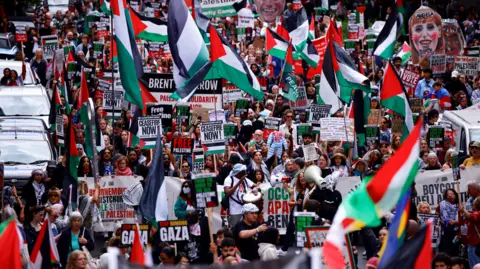
A Home Office minister has said pro-Palestinian marches in British cities have been "hijacked" by people seeking to sow division, as the government's approach to the demonstrations comes under renewed scrutiny.
Alex Davies-Jones said antisemitic activity had taken place during the marches, and insisted the government was prepared to approve bans where necessary.
But she said protest remained a "fundamental right" - and it was important to stress that not everyone on the marches was antisemitic.
It comes as Chief Rabbi Sir Ephraim Mirvis joined calls for a temporary ban on the marches, after two Jewish men were stabbed in Golders Green on Wednesday.
The attack in the north London suburb, declared a terror incident by police, has renewed political debates about over the protection of British Jews.
The government's reviewer of terrorism legislation, Jonathan Hall KC, has called for a "moratorium" on pro-Palestinian marches, arguing it was "clearly impossible at the moment" for them not to "incubate" antisemitism.
Speaking to BBC Radio 4's Today programme, Sir Ephraim said he would "love to see it being implemented implemented ASAP, before the next demonstrations which are planned."
He said that the marches had contributed towards a "tone of Jew hatred within our country", adding: "We are witnessing the normalisation of antisemitism, and it most definitely has not been taken seriously enough."
But Mr Hall's suggestion has been criticised by the Stop the War Coalition, a campaign group that has help organise several previous marches.
The group said it condemned "all forms of antisemitism and racism", but it was "wrong" to connect the marches to any attacks on Jews.
Police forces in England and Wales can restrict protests in certain circumstances, including by stipulating a particular route or saying when it must end.
They can apply to ban protests outright where these powers are deemed insufficient to prevent "serious public disorder", but this requires the approval of the home secretary and is not regularly used.
Last month the government approved a request from the Metropolitan Police to ban the Al Quds Day march in London, marking the the first time a protest march has been banned since 2012.
Speaking to Times Radio, Davies-Jones said the move showed the government was prepared to take action where required, but stressed it was important to balance restrictions with the right to demonstrate.
She said there had been evidence of antisemitic activity on pro-Palestinian marches, citing "chants of death, calls for global intifada, for example".
She added: "That is wrong – but people do have the right to protest the actions of Israel if that's what they deem fit, and I think it's really really important here that we recognise that not everybody on these marches is antisemitic.
"They have been hijacked by certain individuals who are seeking to cause division and hatred in our country, and are using these marches, using these positions to cause fear and intimidation, and that is wrong."
Speaking on Friday, Met police chief Sir Mark Rowley said his force would "go as far as we absolutely can" within the current limits of the law to "maximise the sense of safety" in London.
He added that his force was looking again at what restrictions might be "reasonable" at major protests planned in the coming weeks.
The Stop the War Coalition is planning its annual march to mark Nakba Day, which commemorates the 1948 displacement of Palestinians during the creation of Israel, on 16 May.
There is also a "Unite the Kingdom" rally led by far-right activist Tommy Robinson planned for the same day.
The government commissioned a review of public order and hate crime legislation last year that was expected in February, but is yet to be published.
But speaking on Thursday, Sir Keir Starmer said ministers were looking at "further measures we can take on protests," in a sign that the government is already considering fresh restrictions.
The prime minister also called for police to prosecute people chanting "globalise the intifada" during demonstrations, adding the phrase had left British Jews feeling scared and intimidated.
The term intifada came into popular use during the Palestinian uprising against Israeli occupation of the West Bank and Gaza Strip in 1987.
Jewish groups have described the term as a call for violence against Jewish people. Pro-Palestinian groups have said it is a call for peaceful resistance to Israel's occupation of the West Bank and actions in Gaza.
In December, the Met and Greater Manchester Police said they would adapt their approach to the slogan in the wake of the attack on a Jewish festival on Australia's Bondi Beach, and arrest those using it in chants or on placards.




 English (US) ·