
 2 months ago
55
2 months ago
55
ARTICLE AD BOX
41 minutes ago
Katie RazzallCulture and Media Editor

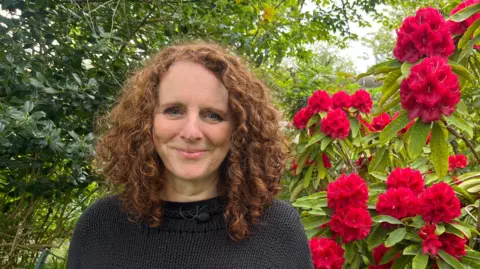 BBC/Katie Razzall
Maggie O'Farrell says she wanted to tell the whole story of Ireland just by one plot of land
As I ring the doorbell of Maggie O'Farrell's Edinburgh home, I wonder with some trepidation whether the acclaimed novelist might have become a bit starry after the whirlwind few months she's just had.
She's been jet-setting between the UK and the US, attending red carpet events and won a Bafta and a Golden Globe for adapting her novel Hamnet for the big screen.
O'Farrell's new novel, Land, is being published off the back of her immersion into the glitzy Hollywood awards race. "It sort of feels like something that I dreamt," she tells me later during our interview.
I needn't have worried that she has had her head turned by LA goodie bags and limos on tap.
She opens her front door, sporting a big smile and a black and red jumper that says LOVE on it, with one of her three cats in tow, and immediately offers me and my BBC colleague some tea.
![Universal Pictures [L-R] Behind-the-scenes image showing director Chloé Zhao on the set of Hamnet with Paul Mescal and Jessie Buckley
They are standing in the middle of a lush green forest.
Chloe with long black hair in long checked grey dress
Paul in moss green top and trousers
Jessie in dark red dress](https://ichef.bbci.co.uk/news/480/cpsprodpb/2ed6/live/0025bf20-496e-11f1-b2fc-834a194ec883.jpg.webp) Universal Pictures
Universal Pictures
[L-R] Hamnet director Chloé Zhao and stars Paul Mescal and Jessie Buckley
This is an acclaimed novelist who chose her own clothes for the awards ceremonies. "They said, 'Do you want a stylist?' but it seemed such a weird idea to me".
Instead, she decided "I'm just going to enjoy it" and wore - appropriately - a red quill headpiece to the Baftas.
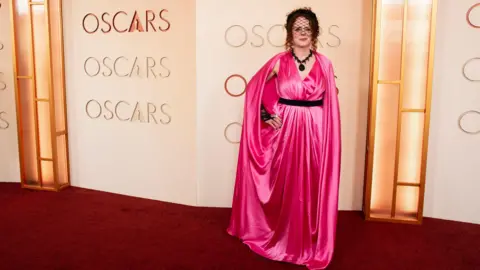
For the Oscars she opted for a black veil and Victorian jet mourning necklace, not just because she was saying goodbye to her creation, but also because Shakespeare's son Hamnet "died when he was really young and he was real".
The awards she won are now hidden away in her basement "until I get used to the idea."
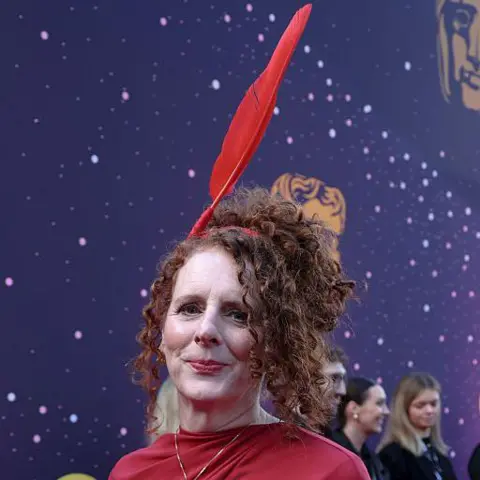 Getty Images
Maggie O'Farrell in her red Shakespearean quill headpiece at the Baftas
More of that later, but we're with her to talk about Land, her sweeping new tale centred around the story of an Irish mapmaker working for the British army in the mid-19th Century.
"I wanted to tell the whole story of Ireland just by one plot of land," she says.
She shows me the handwritten blue book full of her early notes. The first line says "a novel about emigration", with subsequent pages full of stuck in post-it notes of writing.
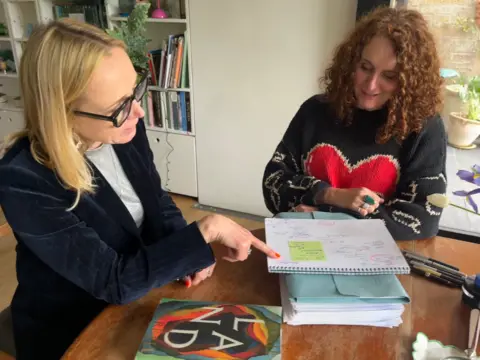 BBC/Katie Razzall
Katie Razzall looking at Maggie O'Farrell's notes for Land
"I was on a train and the first sentence of the book just came into my head - it was, 'His father was ever a man of few words'."
"I wrote an awful lot," she says. "I do remember being very excited and I know the journey went very fast".
The book was inspired by her great-great-grandfather who she discovered made Ordnance Survey maps for the British from 1848, towards the end of the Great Famine in Ireland, which killed at least a million people and forced many more into exile.
"They were doing revisions to the second version of the map of Ireland - and it's obvious why those revisions were needed. Because this huge cataclysm had swept through the country."
Land is her most political novel, the story of a family trying to find their way after what had happened. The book is about colonisation and devastation, set against a backdrop of families left to die of starvation on estates owned by British aristocrats and landowners.
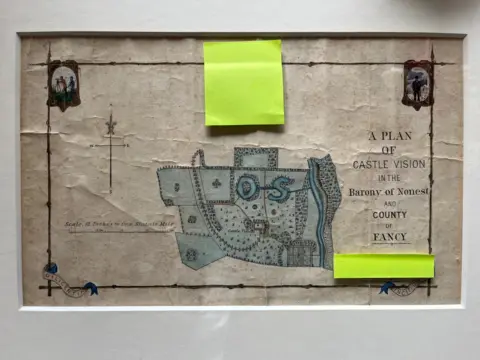 Maggie O'Farrell
This map of an imaginary place was created by the author's great-grandfather for his father
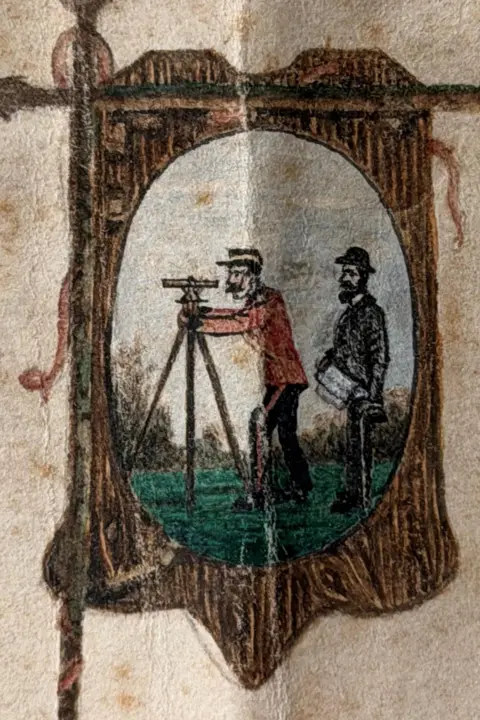 Maggie O'Farrell
A detail on the map shows a tiny painting of O'Farrell's great-great-grandfather, with a British soldier
"Whole villages had been wiped out, estates were redrawn and so many people had been evicted, it was necessary to do those revisions. But I couldn't really get my head around what it must have been like doing that work, being someone who'd lived through it."
I ask whether she thinks Britain's role in the Great Hunger is still unresolved.
She says it's "complicated."
Multiple factors caused the famine, including the potato blight that destroyed the main source of food, and the political and socioeconomic circumstances of British colonial rule.
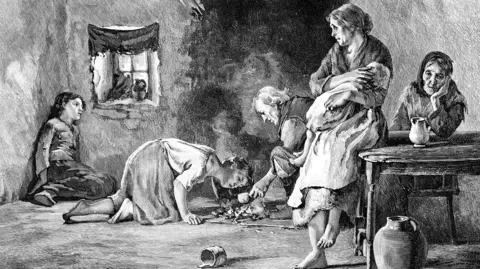 Getty Images
The Great Hunger of 1845-52 led to mass starvation in Ireland, about one million people died and another million fled the country
Other food crops were exported to Britain as Irish people starved. The ballad, The Fields of Athenry, refers to it as "Trevelyan's corn", after the civil servant who had responsibility for administering relief during the famine, Charles Trevelyan.
O'Farrell calls his attitude to the famine "upsetting and horrifying".
"He describes it in a letter as an act of God for an idle, indolent, ungrateful, unself-reliant people. A year after he wrote that letter he was given a knighthood for his work in famine relief."
But the knighthood stands. "I would quite like the British Government to rescind it. I don't think he should have it".
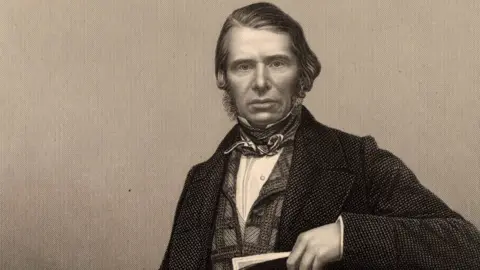 Getty Images
Charles Edward Trevelyan, who was in charge of the relief effort, limited the British Government's aid
O'Farrell was born in Northern Ireland and moved to Britain as a child, to Wales then Scotland.
Being displaced means "you walk alongside, all your life, a kind of ghost self. There's always a sense of 'who would I have been if we'd stayed?'"
References to past selves and ghosts are a thread in many of her novels.
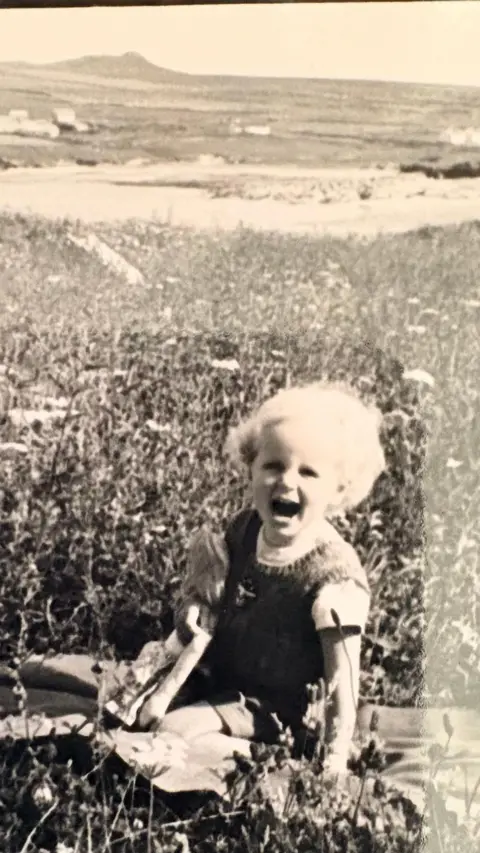 Maggie O'Farrell
The novelist was born in Northern Ireland, and spent her childhood in Ireland and Wales, before moving to Scotland
The family moved in the 1970s when tensions between Britain and Ireland were fraught and "it was not easy actually to be Irish in Britain at that time".
She describes "teachers looking me in the face as a child and saying, 'is your dad in the IRA?'"
Years later she recalls working for a London newspaper, where a colleague took a message from her father and then told her: "It's so funny, whenever I speak to your dad, I always think he's going to give us a five-minute warning."
O'Farrell called them out for "implying my dad is a terrorist bomber. It was a strange moment. Everybody was slightly offended by my fury".
Relations between Ireland and Britain have improved since, and many people will have differing opinions as to why.
O'Farrell wonders if it's "because people are less racist or because maybe there are newer waves of immigrants who are absorbing that kind of hostility".
'Not hating other people'
The struggles around borders and ownership of land are as painfully felt in many parts of the world today. We met soon after the attacks in Golders Green.
"I think the rise of racism is really, really concerning for everybody, not just Jews, not just Muslims, everybody, I think, and everyone who can be considered by some people to be 'an other'," she says.
"It's really frightening. And I think all of us need to work hard at trying to teach our children and our children's children about not hating other people for being slightly different from yourself."
 BBC/Katie Razzall
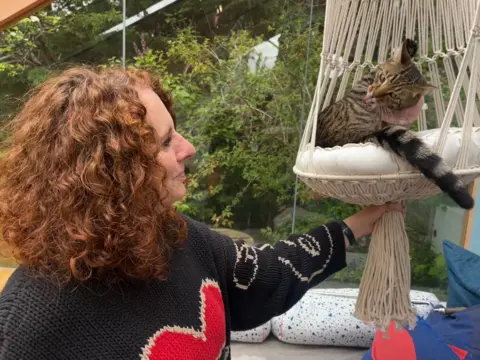
Maggie O'Farrell with her cat Gryphon in his hammock in her writing studio
O'Farrell shows me where she writes, taking me down her garden, "my commute to work," past a treehouse and a run for the rescue tortoise, to her glass-framed studio.
"It's a very nice place to be. It's just something about the daylight and the peacefulness of it. The cats come with me and sometimes the tortoise as well."
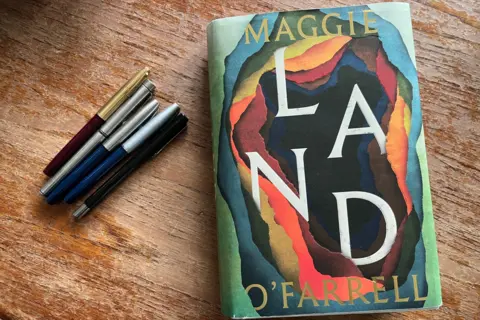
She shows me her collection of vintage fountain pens, telling me she's "very fetishistic about stationery".
 BBC/Katie Razzall
The author uses fountain pens in the early stages of creating her novels
Despite her 10 novels, a Women's Prize for Fiction for Hamnet and the film awards, O'Farrell can still "absolutely" lose confidence in her own abilities.
She has weeks "where I sit with my head in my hands thinking 'I'm going to have to retrain, this is a disaster, I need to get a different job.'"
In fact, she's in her prime. She's sold more than eight million books worldwide and is translated into 44 different languages.
Land has been optioned by the same producer behind Hamnet, and O'Farrell confirms she plans to write the screenplay. "I think I want to. I just find it hard to let it go because it's so personal."
Perhaps it will lead to another Hollywood awards race. "Peculiar" and "very surreal" is how she sums up the last one.
At the Academy Awards in March, she was waiting to take her seat and heard a voice behind her.
"I thought to myself, 'That's so weird, that guy sounds exactly like George Clooney'. And then I thought, 'That's because it is George Clooney'".
 Getty Images
Maggie O'Farrell at the 98th Academy Awards, where Jessie Buckley won the best actress Oscar
We persuade her to take us into her basement to look at her Hamnet gongs. She unlocks the door, saying she's "feeling really ungrateful now" and reiterating that "this is just where they are at the moment".
The Golden Globe and the Bafta are still wrapped up in their boxes on a shelf. "I do care but I just find it a little bit too flashy to have them out…"
The Golden Globe is particularly heavy.
"Somebody handed it to me on stage and I really nearly dropped it on Steven Spielberg's foot. Can you imagine?"
For now, her children are the ones enjoying the awards, by playing with them.
"There's a lot of, 'And the award for best sister goes to…'."
She has tentatively started another novel but has "a superstition talking about things that I haven't finished yet".
Spielberg might want to get some protective footwear just in case.
Land is published on 2 June 2026.


 English (US) ·