
 2 months ago
62
2 months ago
62
ARTICLE AD BOX
6 minutes ago
Faisal IslamEconomics editor

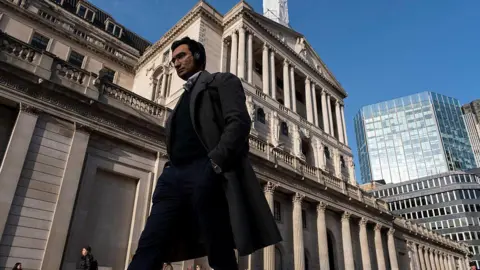 Mike Kemp/In Pictures via Getty Images
No interest rate rise is going to force an oil tanker through the Strait of Hormuz, or clear the "hazardous area" of mines.
The Bank of England repeatedly made the point in its latest meetings' minutes and new numbers that the bigger picture is out of anyone's control - at least here in Britain.
There was an important message, however, in the deliberations and forecasts around the decision to hold rates.
Rate cuts are definitely off the agenda, some form of rate rise is more likely than not, and if oil prices sustain at Thursday morning's $125 peak for the rest of the year, rates might need to go above 5% this year.
Essentially the Bank was trying to provide detail around some of the "ifs" and "maybes" to manage expectations of what outcomes are plausible if the Gulf impasse lasts several months.
The recent sharp fall in oil prices after the announcement of the ceasefire was built on the assumption of the return to some sort of normality within days or weeks.
'Difficult circumstances'
What on earth are households - already squeezed at the petrol pumps, facing a rise in the price of gas and electricity in the summer, food prices too - supposed to think about a significant spike in mortgage costs?
I put that question to the Bank of England governor, Andrew Bailey.
He responded: "These are very difficult circumstances. This is a major increase in energy prices. No question about that.
"It's a very big shock in that sense and of course, it is felt by households.
"Inflation is bad for everybody, but it's particularly bad for the least well off. Things like energy and food [makes up] a much bigger proportion of spending by those on lower incomes and so we have to be very, very sensitive to that.
"So this is a difficult situation. Our job is to sort of chart the best course we can through it."
The governor is managing a range of views as well as a wide field of uncertainties.
He pointed to the fact that the oil price had moved by $10 per barrel even from mid-morning on Thursday to mid-afternoon.
While in the most benign scenario of immediate and sustained falls in energy prices, the governor says rate rises might be avoided, the markets are now assuming a rise in June or July, on the basis that the blockades will remain in place.
In any event, the markets are pushing up longer-term rates without waiting for the Bank.
This has already been seen in fixed-term mortgage rates, which the Bank said was expected to result in an average £80 a month rise in payments.
Just over half of mortgaged households will roll off fixes and are expected to see higher monthly payments over the next three years.
This is also more than a headache for the government. Effective government borrowing rates are going up around the world because of the crisis. And UK rates have been more volatile than some other G7 nations.
I asked the governor if the UK had a particular problem. He said the strength of sterling showed that this issue was not about the UK.
"It's all to do with the conflict," he said. "It's really been driven by both actual developments in the conflict, but also what gets said about the conflict.
"I think that the UK 'premium' is interesting. The exchange rate doesn't move much at all.
"That's one thing I look at when I'm judging: 'Is there a particular UK story here? Is the UK somehow different to other countries?'.
"The exchange rate, in my experience, is actually not a bad at all guide to that, and it hasn't moved much. It's trading actually around the upper end of the band it's been in since Brexit."
There is still some hope that the Gulf situation resolves itself soon. The message from the Bank is that households and businesses need to have in mind what will happen if it takes several months.



 English (US) ·