
 1 month ago
50
1 month ago
50
ARTICLE AD BOX
13 minutes ago
Emery MakumenoBBC Africa, Kinshasa

 AFP via Getty Images
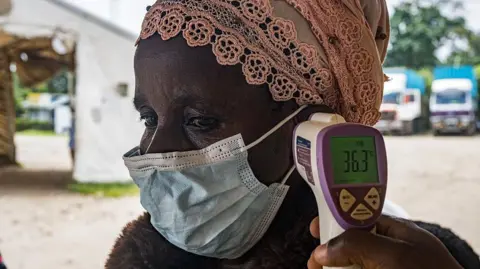
At least 131 people have died during the Ebola outbreak
Fear has gripped Ebola-hit areas in eastern Democratic Republic of Congo as the suspected number of deaths continues to rise, as officials say they are struggling to catch up to an outbreak that may have previously been spreading undetected.
"Ebola has tortured us," says a taxi rider in his late twenties in the gold-mining town of Rwampara.
"I am scared because people are dying very fast... We are really afraid."
Following a visit to Ituri province, the epicentre of the outbreak, over the weekend, Congolese Health Minister Dr Samuel Roger Kamba acknowledged health teams are playing catch-up with the virus, which may have been circulating earlier than first detected on 24 April.
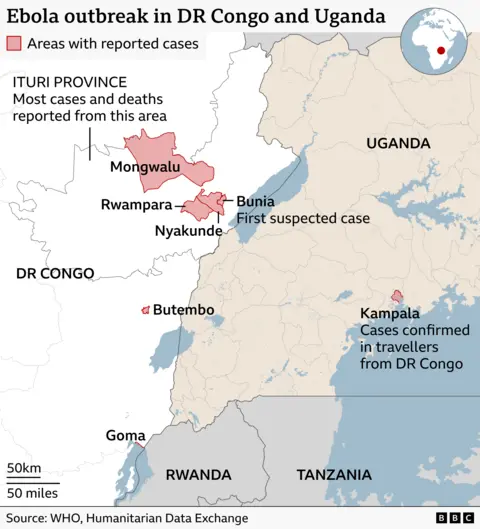
The presumed patient zero is a nurse who died in the provincial capital Bunia, but was buried in Mongwalu, also a gold-mining town. Most of the suspected cases and deaths have been reported there and in neighbouring Rwampara.
Rwampara resident Fred Kiza told the BBC that "there is fear", which he calls "normal when there's a disease like this."
"It would be good if they gave us masks to protect ourselves."
As of Tuesday, there are 513 suspected cases and at least 136 deaths, officials say. One person has also died in neighbouring Uganda.
Cases have also been identified in Butembo city and rebel-controlled Goma in North Kivu province, as well as in South Kivu province.
Health officials say that several deaths occurred in the community without being reported to the authorities, meaning they could not be investigated at the time.
According to the health ministry, formal community alerts were only registered from 8 May.
"At community level, this hasn't been effective," Dr Kamba explained. "It means someone may have died before him [the presumed index case], or someone else may have been sick before him, but no one reported it."
He added: "We really need to look within the community to understand what happened - how people became ill and sometimes even died without any report being filed."
A virus hiding in plain sight
The outbreak has been caused by the Bundibugyo strain of Ebola. DR Congo - which is currently facing its 17th outbreak of Ebola - is more familiar with the Zaïre species.
Bundibugyo has caused only two outbreaks before - in 2007 and 2012 - where it killed around 30% of people infected.
Dr Kamba explained the symptoms: "There is heavy bleeding everywhere, very high fever. But Bundibugyo can show fewer obvious signs, which delays diagnosis because people think, 'No, this is just malaria.'"
That delay, officials say, may have allowed the virus to spread silently.
In Mongwalu, some deaths were attributed not to illness, but to witchcraft. The belief became known locally as the "coffin phenomenon" - the idea that anyone who touched the coffin of a deceased person would also die.
International charity Save the Children said the Bundibugyo strain has not been seen in Ituri before. The limited testing that was available in the province was testing for the Zaïre strain and not coming up positive.
"By the time the Bundibugyo strain was detected, it had already spread quite far. We are in a game of catch-up," its DR Congo representative Greg Ramm said in a statement.
Authorities warn that the spread of the virus into large urban centres presents serious challenges.
Despite Dr Kamba's visit to Bunia over the weekend, residents feel that progress to curb the spread of the virus has been slow.
"If there's no treatment centre here in the capital," one resident asked, "then what about other areas?"
Bunia in Ituri, and Butembo and Goma in North Kivu, are home to hundreds of thousands of people, yet none has a fully operational Ebola treatment centre five days into the declaration of the outbreak.
Residents in Goma - eastern DR Congo's biggest city - tell the BBC that basic public health measures, such as avoiding handshakes, limiting gatherings and regular handwashing, are widely ignored.
"I'm heading to the border to report on people stranded there," said José Mutanava, a local journalist. "I'm wearing a face mask, but not many people are."
Another resident, who asked not to be named, said: "Nobody can follow the barrier measures - maybe only when we see more deaths. Today in the city centre I saw only four people wearing masks."
Others say daily survival takes priority.
"It's too much to ask people struggling to eat to follow these rules," one resident said.
Eastern DR Congo is badly hit by conflict, bringing additional difficulties in dealing with the virus.
Save the Children said the Ebola outbreak is a "new massive crisis on top of an already difficult situation".
"It is in an area of conflict, an area of humanitarian crisis, with hundreds of thousands of people displaced, and healthcare systems are already severely compromised," it added.
Currently, four of the affected areas are in Ituri province: Mongwalu, the epicentre of the outbreak, as well as Bunia, Rwampara and Nyakunde.
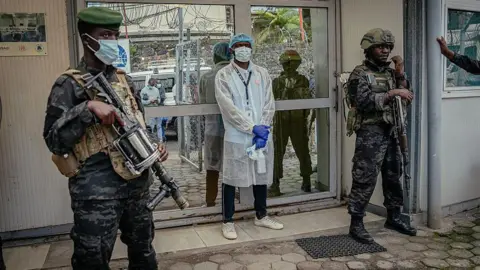
In North Kivu, Goma is controlled by the M23 rebel group, while the province's second largest city, Butembo, is also affected by militia activity.
 AFP via Getty Images
Goma, the main trading hub in eastern DR Congo, is controlled by rebel forces
The US has announced $13m (£9.7m) in emergency assistance for DR Congo and Uganda and says it is considering further funding through the UN's pooled humanitarian fund, alongside travel restrictions linked to the outbreak.
An American national, Dr Peter Stafford, is among the infected after he tested positive while working at Nyakunde Hospital in Ituri.
The doctor, his wife and another colleague had been treating patients when the outbreak started, Serge, the Christian missionary group they were working for, has said.
According to the US Centers for Disease Control and Prevention (CDC), a US national was evacuated to Germany for treatment, adding that it is working to evacuate at least six other Americans who were exposed.
On Sunday, the World Health Organization (WHO) declared the outbreak a public health emergency of international concern, after confirmed cases were reported on 15 May.
For now, Congolese authorities say they are relying on hard‑learned experience, and public‑health measures, to confront what is now the country's 17th Ebola outbreak.
 Getty Images/BBC



 English (US) ·