
 2 hours ago
8
2 hours ago
8
ARTICLE AD BOX

 Los Angeles Times via Getty Images
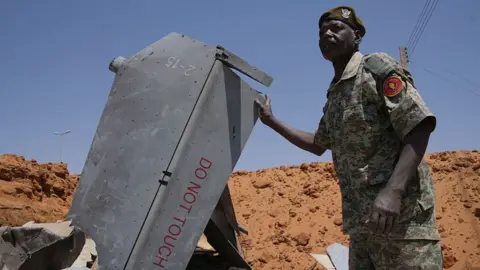
El Obeid has been targeted in several drone attacks including when this picture was taken in March
A drone strike on a funeral procession at a cemetery in the Sudanese city of el-Obeid has killed at least four people and injured several others, two rights groups, Sudan Doctors Network and Emergency Lawyers, have said.
Both groups blame the paramilitary Rapid Support Forces (RSF) for the attack. Emergency Lawyers said it was part of a series of drone strikes that started on Wednesday evening in which at least 23 people have died in all.
The RSF has not commented.
El-Obeid, currently in the hands of the army, is a key battleground in Sudan's three-year civil war which began after the leaders of the army and RSF fell out over the future direction of the country.
The fighting has created the world's worst humanitarian crisis with more than 11 million people forced from their homes and 28 million facing acute hunger.
There are no reliable figures for the death toll, but it is thought to be at least 50,000.
In addition to the attack on the cemetery, Emergency Lawyers said that drones struck homes in a residential neighbourhood, the airport district and areas surrounding an army base. Thirteen civilians were killed, the group said, as civilians gathered near destroyed houses.
It also reported that five civilians were killed in earlier attacks.
"It is tragic. The roofs of houses collapsed on their occupants. When you look at some houses, you feel no-one could have survived," one resident told the AFP news agency in the wake of the attacks.
In another attack a driver of a lorry carrying food supplies died when his vehicle was struck on Thursday, both Emergency Lawyers and Sudan Doctors Network have said.
The two groups describe systematic and repeated attacks on civilians in el-Obeid for several days.
The city is in the country's oil-rich Kordofan region - which is divided into North, South and West Kordofan states.
It become a major front line in the war due to its strategic significance, sitting between RSF-controlled areas in the west and eastern areas where the army is mostly in charge.
Analysts say whoever controls the region effectively controls the country's oil supply, as well as a large chunk of the country.
More on Sudan's civil war:
 Getty Images/BBC







 English (US) ·