
 4 months ago
98
4 months ago
98
ARTICLE AD BOX
Nadine YousifSenior Canada reporter

 EPA
EPA
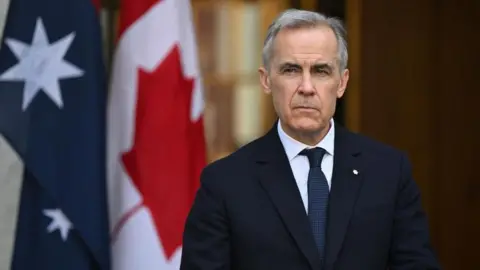
Prime Minister Mark Carney is facing criticism at home as he tries to strike a balance on the US-Israeli military action in Iran, as Canada scrambles to get its citizens out of the region and faces the risk of being dragged into a widening conflict.
Carney expressed strong support for the initial strikes when they launched a week ago, arguing for the value of preventing Iran from obtaining a nuclear weapon and its regime "from further threatening international peace and security".
Days later, he said it was a position he took "with regret" because the strikes appeared "inconsistent with international law".
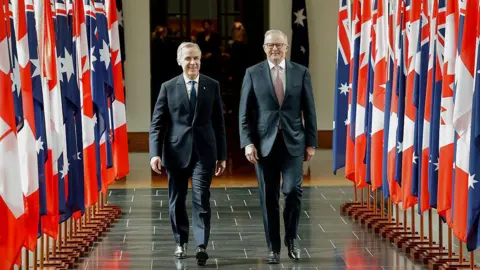
Along with Australian Prime Minister Anthony Albanese, whom he was meeting, Carney called for a "rapid de-escalation" in the conflict.
And while the Canadian prime minister's response after the initial strikes was more firm than that of the UK, France and Germany - who jointly condemned the Iranian regime, but called for a "resumption of negotiations" - he now appears to be trying to walk more a more narrow diplomatic path.
He's not alone in that challenge.
Since the joint statement by the UK, France and Germany, all three have shifted positions.
France has increased its regional presence after an Iranian strike hit one of its bases in the United Arab Emirates.
The UK has agreed a US request to use British military bases for "defensive" strikes. A US B-1 Lancer bomber capable of carrying 24 cruises missiles has landed in the UK on Friday.
And German soldiers are ready for defensive measures if needed, though Chancellor Friedrich Merz has warned of the danger of getting bogged down in "endless wars".
Carney has also not "categorically" ruled out military participation in the region, saying Canada "will stand by our allies, when it makes sense".
Members of his own Liberal Party have openly criticised his handling of the events.
Lloyd Axworthy, who served as foreign minister from 1996 to 2000, said in an opinion piece published in the Toronto Star on Saturday that Carney's support for the strikes was a notable departure from Canada's position decades earlier, when it refused to support the 2003 invasion of Iraq by the US.
"We are embracing the very doctrine we used to reject," Axworthy wrote.
Liberal MP Will Greaves said on social media that "Canada cannot endorse the unilateral and illegal use of military force... while also insisting that our sovereignty, our rights and our independence must be protected".
This was an apparent reference to President Donald Trump's repeated comments about Canada becoming a 51st US state.
Others, including the Conservative opposition, have said Carney's stance has been "contradictory" and "incoherent".
Roland Paris, director of the Graduate School of Public and International Affairs at the University of Ottawa and a fellow at Chatham House, told the BBC that Carney's stance had been "a bit hard to decipher".
 Getty Images
Carney met Australian PM Anthony Albanese this week
He added that the reaction sparked by Carney's position on the Iran war was a sign that the vision of clear-eyed pragmatism he laid out in a major speech in Davos, Switzerland, in January, while "sensible", is difficult to implement.
In that address, which garnered global headlines, the prime minister urged middle powers like Canada to come together against "great powers".
He also argued for a "principled" approach to foreign policy, consistent with values set out by the United Nations charter.
The speech was widely interpreted as being directed at Trump, who at the time was talking about a US takeover of Greenland.
Paris, the University of Ottawa expert, said it set out a "broad framework" for middle powers, but did not provide guidance on how countries can balance their values with real-world complexities.
"It was going to be hard, no matter what, to reconcile the two elements of his Davos speech," he said.
He added that he believes Carney eventually landed in "a better place" with his response - one that addresses Canadians' concerns about both the Iranian regime but also the risk of being dragged into an escalating war.
Thomas Juneau, a professor at the Graduate School of Public and International Affairs at the University of Ottawa, argued that Carney's stance is likely driven by his need to manage relations with Trump.
Canada sells the bulk of its products to the US and is heading into high-stakes trade talks with the Trump administration.
"Critics are therefore not wrong to say that Canada has nothing to gain from endorsing his war... but they miss the reality that Canada has much to lose."
On Friday, Canada's Foreign Minister, Anita Anand, made clear that Canada has "no intention to participate in Operation Epic Fury".
She also said Canadian military officials were in contact with allies "in order to ensure that de-escalation and the protection of civilian life and civilian infrastructure is top of mind".
On Thursday, Canada's top military commander, chief of the Defence Staff Gen Jennie Carignan, told media that "our Gulf partners may require defence and support".
"This would be the type of military options that we could consider," she said.
Anand also said that she and the prime minister welcomed the diversity of views within the Liberal Party, speaking ahead of a caucus meeting where they will discuss the conflict.
"I have great respect for my caucus colleagues across the board, and very much look forward to hearing their viewpoints," she told reporters in a conference call on Friday, where she put forward Ottawa's plans to help Canadians seeking to leave the region.
A poll of Canadians by Angus Reid after the US strikes on Iran suggests that people are divided on the issue, with 48% opposed or strongly opposed, and 35% in support. The remaining 17% say they are unsure.

 English (US) ·