
 3 months ago
78
3 months ago
78
ARTICLE AD BOX

 Noel Christ/Airbus
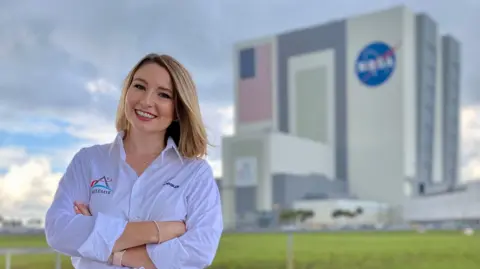
"I don't think stereotypes like that have ever bothered me," says Sian Cleaver
Sian Cleaver said the "Essex girl" stereotype has never held her back when pursuing her dream of becoming an astronaut and working on a spacecraft that would take humans to the moon.
The 36-year-old from Chelmsford, Essex, works as a spacecraft engineer for Airbus in Germany, which has built the propulsion system for the Orion spacecraft on Nasa's Artemis II mission.
"I don't think stereotypes like that have ever bothered me. I've never worried about sticking to particularly girlie things," Cleaver said.
"I don't think I've ever been bothered by the trends because I've been so far removed from it," she added.
Cleaver said she was always interested in astronomy while a pupil at Chelmsford County High School and later studied physics at Durham University.
She encouraged young girls and women to ignore stereotypes and follow their dreams.
"If you've got big ambitions and it feels like people are bogging you down, just got for it anyway.
"I always wanted to be an astronaut and that is always what inspired me and gave me drive and I still have that dream," she said.
Artemis II was supposed to launch in February, but after a pre-test flight revealed a technical issue it was delayed and now the next possible dates are in early April.
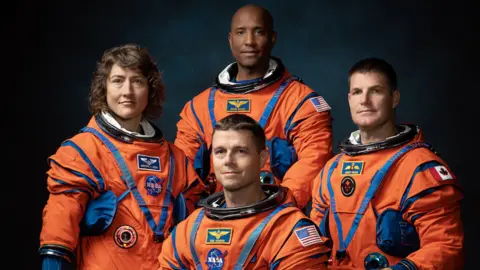
Four astronauts, including Christina Koch, will take the spacecraft to orbit the Moon in a 10-day mission and hopefully become the closest humans have been to the lunar surface since 1972.
Koch said she wanted to become an astronaut after seeing a picture of the Earth taken by Bill Anders, a crew member of the Apollo 8 mission in 1968.
Cleaver said: "I want to see the first woman walk on the moon. Artemis II will see a woman orbit the moon."
'Diversity needs to be visible'
 NASA
NASA
Christina Koch (far left) is the only female crew member of Artemis II
The Artemis II crew are set to travel to the Moon powered by the European Service Module, which includes large solar arrays made by Cleaver and her team in Bremen.
Cleaver said women were working on the project, however, they were a "minority".
"Diversity brings different perspectives and a different way of working and it's a real shame that it is not so visible," she added.
Cleaver said she delivers talks at schools because "it's good for younger people see women doing jobs like mine. So that when they start thinking of these jobs in the future they don't automatically picture a man doing them."
"There's definitely not enough role models, particularly at higher levels," she added.
More than 9.4m people work in Stem across the UK but women represent 25% of this workforce, according to Women in Tech.
"I am still super excited and passionate about space and that is what gives me the drive.
"It feels like I have to push and fight extra hard compared to some of my peers and that has always frustrated me.
"I feel like a weighted responsibility because I feel like there are younger women who are looking up to me, but I wish there was more that I can look up to as well."
"The fact that we are going back to the moon, there is a whole generation of people on this planet who haven't lived through a moon landing and we are about to live that again," she said.
"I do feel very privileged to be part of making history."



 English (US) ·